
Attic Whispers from The Blue Mountains; Fact or Fiction #7
[September 2026 Edition]
A headless body on a boat. An international conspiracy. And a secret that someone is willing to kill to protect.
Greetings from my attic in the Blue Mountains, my friends!
Last newsletter I asked you whether Avicenna’s Canon of Medicine remained the standard medical textbook in European universities until the seventeenth century — and whether it represents the most influential single work in the history of medical science.
Here is your answer.
Fact. Both parts of it.
Ibn Sina completed the Canon of Medicine around 1025 AD. It was translated into Latin in the twelfth century and adopted by European medical schools almost immediately. It remained a core medical text at universities including Montpellier, Bologna, and Oxford for over five hundred years. Its influence on European medicine — on anatomy, pharmacology, and clinical diagnosis — was so pervasive that some historians argue it shaped the foundations of Western medicine more than any other single document. Whether it is the most influential work in the history of medical science is a question scholars still debate. That it belongs in the conversation is not.
Now. Before I tell you about Book #5, here is today’s statement:
Astrophysics has produced some of the most disorienting discoveries in the history of human knowledge. One of them is this: the observable universe — everything we can see, measure, and detect — accounts for only about five percent of what exists. The remaining ninety-five percent is composed of dark matter and dark energy, neither of which has ever been directly observed. We know they exist because of their gravitational effects. We have no idea what they actually are.
Fact or fiction?
The answer is coming in the next newsletter.
But first, let me tell you about The Curious Case of the Missing Head.
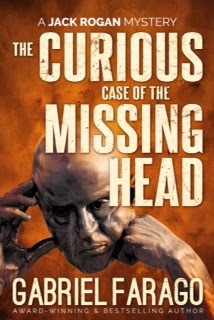
A headless body on a boat is not the kind of thing Jack Rogan expects to find when he agrees to help a friend. But that is the nature of the cases that find him — they begin with one question and open into something far larger, far darker, and far more dangerous than anyone anticipated at the start.
The missing head of the title is not a metaphor. It is a literal object, and its absence is the first clue in a chain that leads Jack from Australia into the world of international astrophysics, criminal cartels, and a scientific discovery so significant that the people who made it are now in mortal danger.
I want to tell you something about writing this novel. I have always been fascinated by the intersection of current science and human ambition — the point where a discovery stops being purely academic and starts attracting the kind of attention that gets people killed. Astrophysics gave me a world I had not explored before in this series, and the research took me into territory that was genuinely astonishing. The science in this novel is real. The conspiracy wrapped around it is fiction. The line between the two is, as always, deliberately blurred.
Jack is also carrying something personal in this novel — a thread from his own past that has been running quietly through the series and surfaces here with new urgency. He is not simply solving a case. He is looking for something that belongs to him.
The curious case of the missing head turns out to be about much more than a body on a boat. It always is, with Jack Rogan.
The answer to today’s statement is coming in the next newsletter.
Gabriel
P.S. The Curious Case of the Missing Head won a Gold Medal in the Fiction Thriller Conspiracy Thrillers category at the 2020 Readers’ Favorite Annual Book Award Contest and was named Outstanding Thriller/Suspense of 2020 by the Independent Author Network. I mention this not to boast but because awards matter to me as a measure of whether the work is reaching the readers it was written for.
If you haven’ read The Curious Case of the Missing Head before, you can get it right herenow:
STAY SAFE, STAY CHEERFUL, and please STAY IN TOUCH.
Sincerely,
Gabriel Farago


